
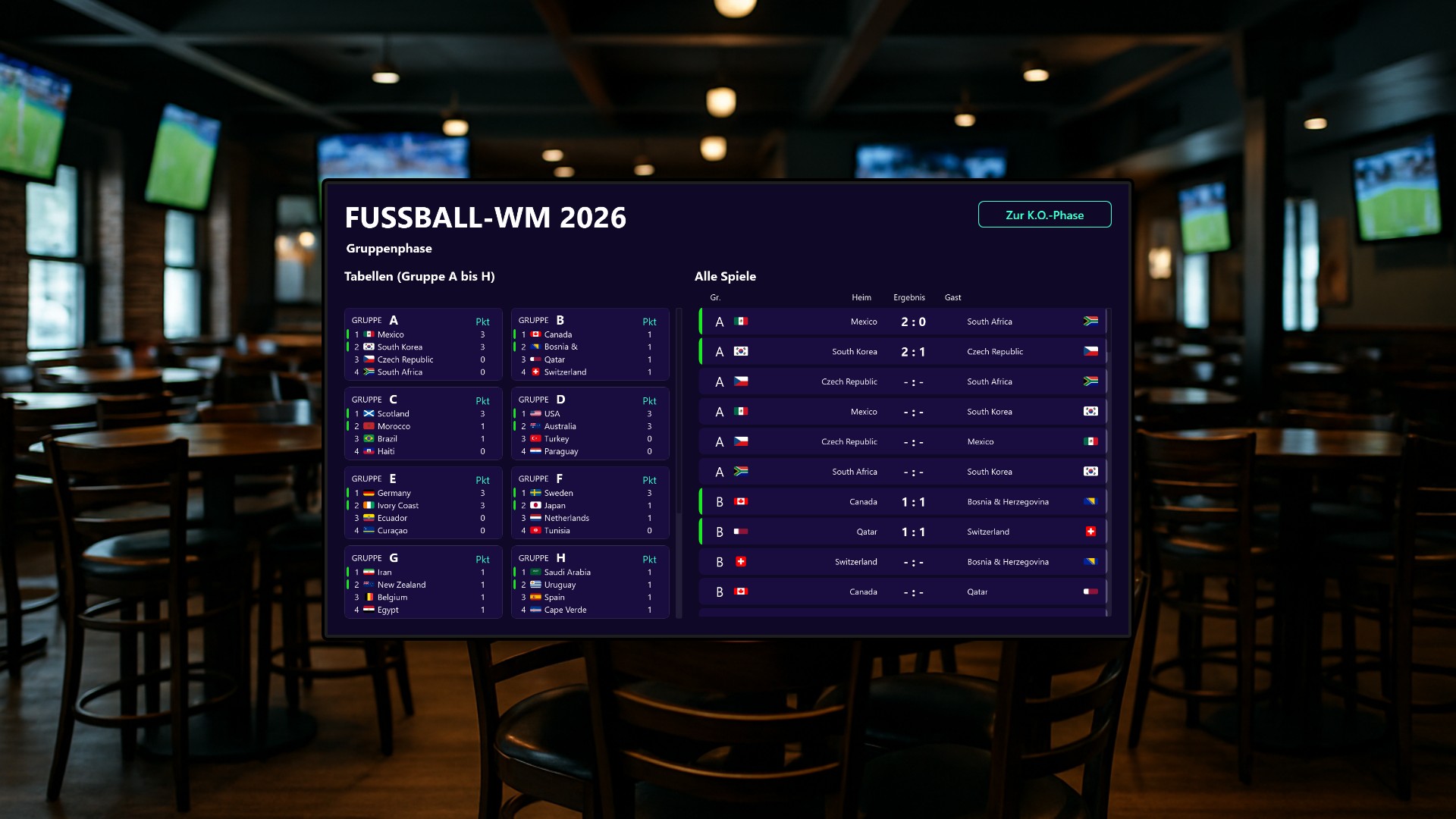
A four-week tournament with 48 teams, twelve groups, and a 104-match schedule is a wonderful thing to follow and a nightmare to keep up to date by hand. If you have ever tried to maintain a paper standings sheet or a manually edited slide on a wall during a major football tournament, you know the drill: every result means new points, new goal differences, new rankings, and a fresh round of erasing and rewriting. In this article we build a board that takes that work off your plate completely for the 2026 FIFA World Cup.
The idea is simple. The board pulls the real draw and live results from a free, openly available World Cup data feed, recalculates every table on its own, and keeps the picture on the wall in sync with what is actually happening on the pitch. Nobody has to touch it once it is running.
What the board is for
This is a fully automated tournament tracker designed to run unattended on large screens. Think offices, sports bars, fan zones, company canteens, or reception areas - anywhere a crowd wants to follow the World Cup at a glance without staring at a cluttered TV broadcast. It is meant to be glanceable from across a room: clean, branded, and always current.
The target audience is anyone running a public or semi-public screen who wants a tidy football overview rather than a busy broadcast graphic. Because everything is calculated from the live feed, the board never drifts out of date, and there is no manual data entry to get wrong.
The group stage screen
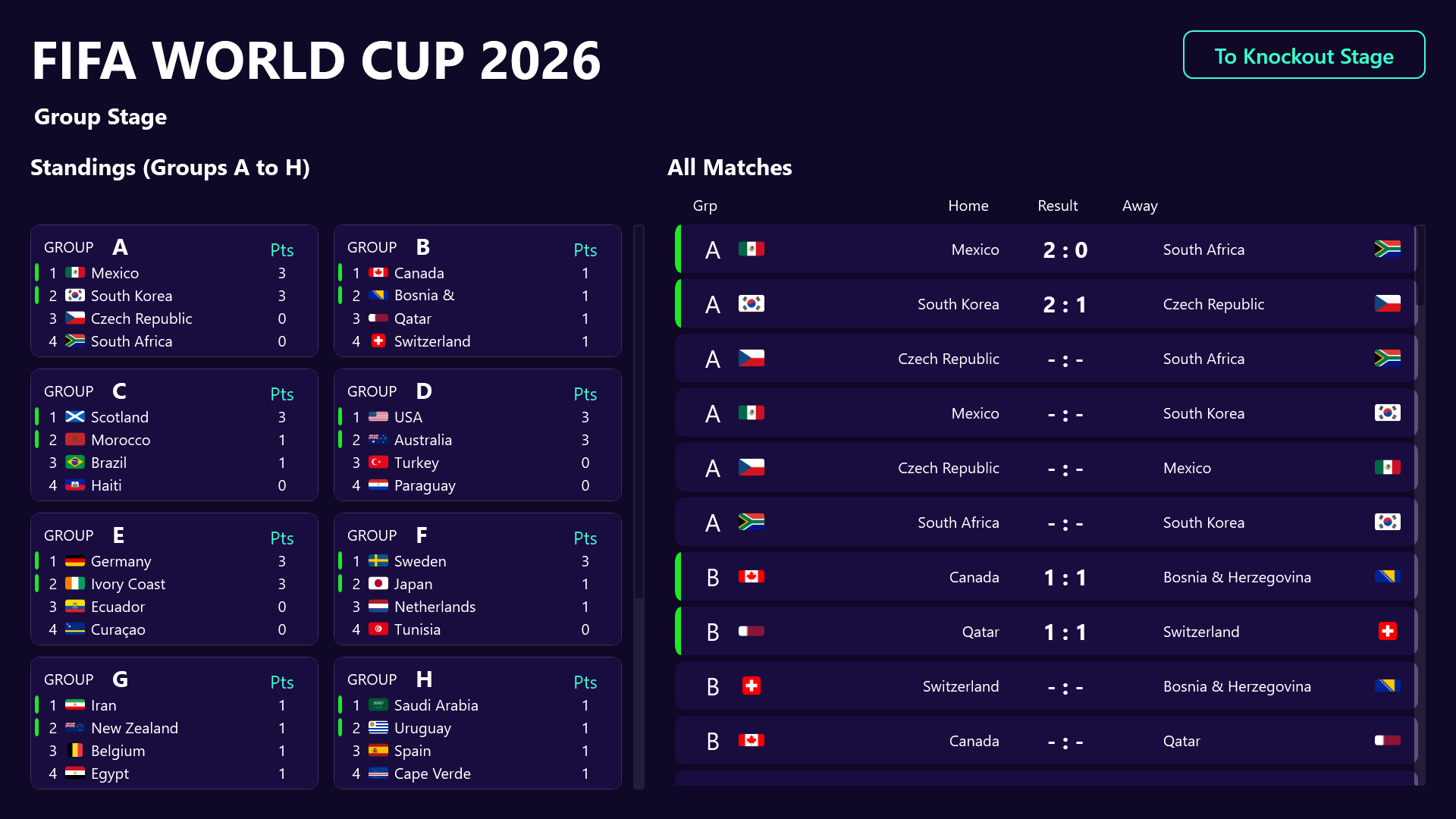
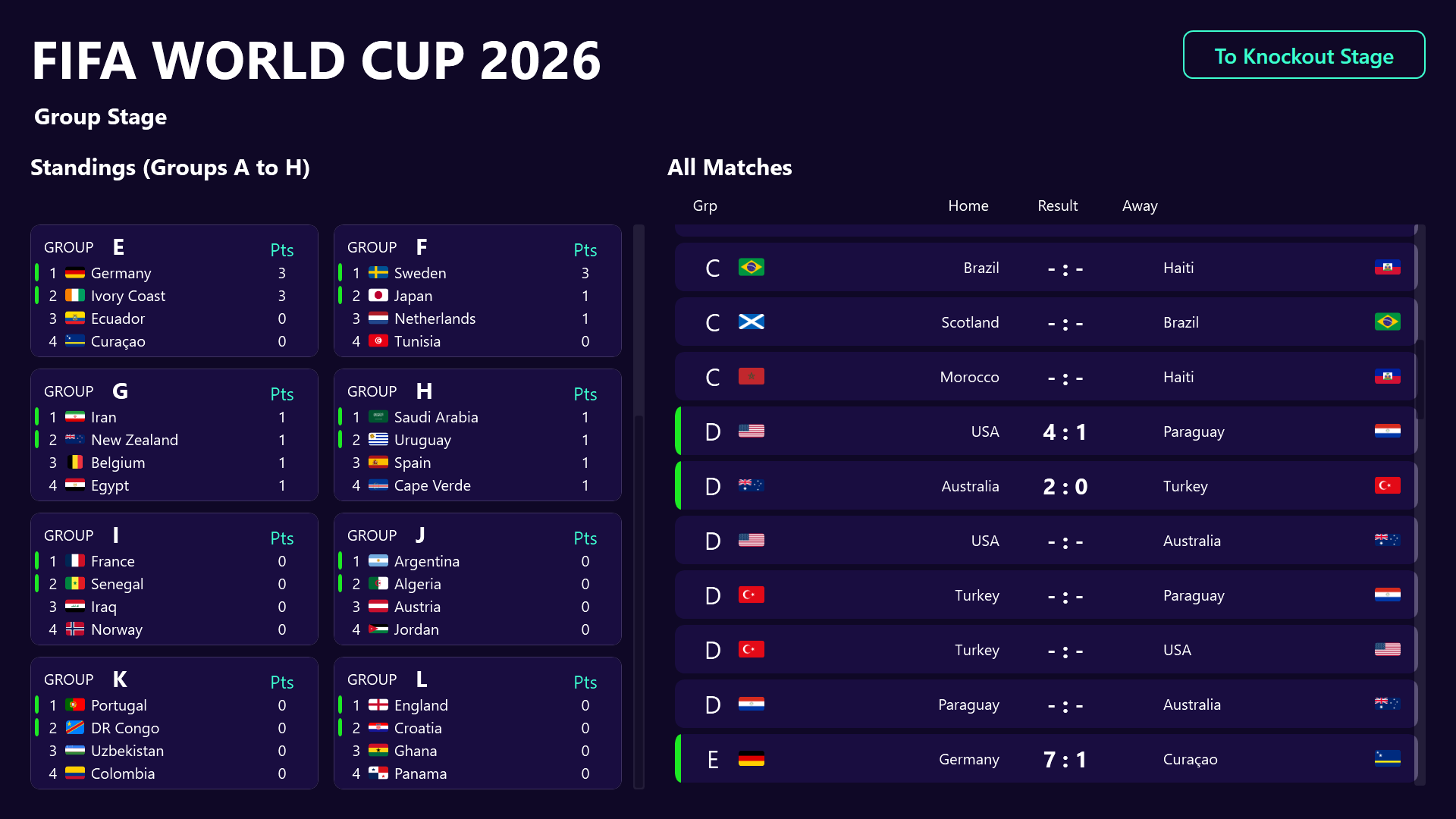
The first screen shows the group stage: all twelve groups from A to L, each as a compact card with country flags, ranking, and points. The layout is built so a viewer can read the state of any single group in a couple of seconds and scan the whole tournament in a few more.
What makes this screen useful is that the standings are not hard-coded. The table, goal difference, and placement are all derived from the actual match results and rebuilt from scratch on every refresh. When a match finishes and the feed updates, the points tick over, the goal difference recalculates, and the teams reorder themselves into the correct ranking without anyone lifting a finger.
The knockout bracket
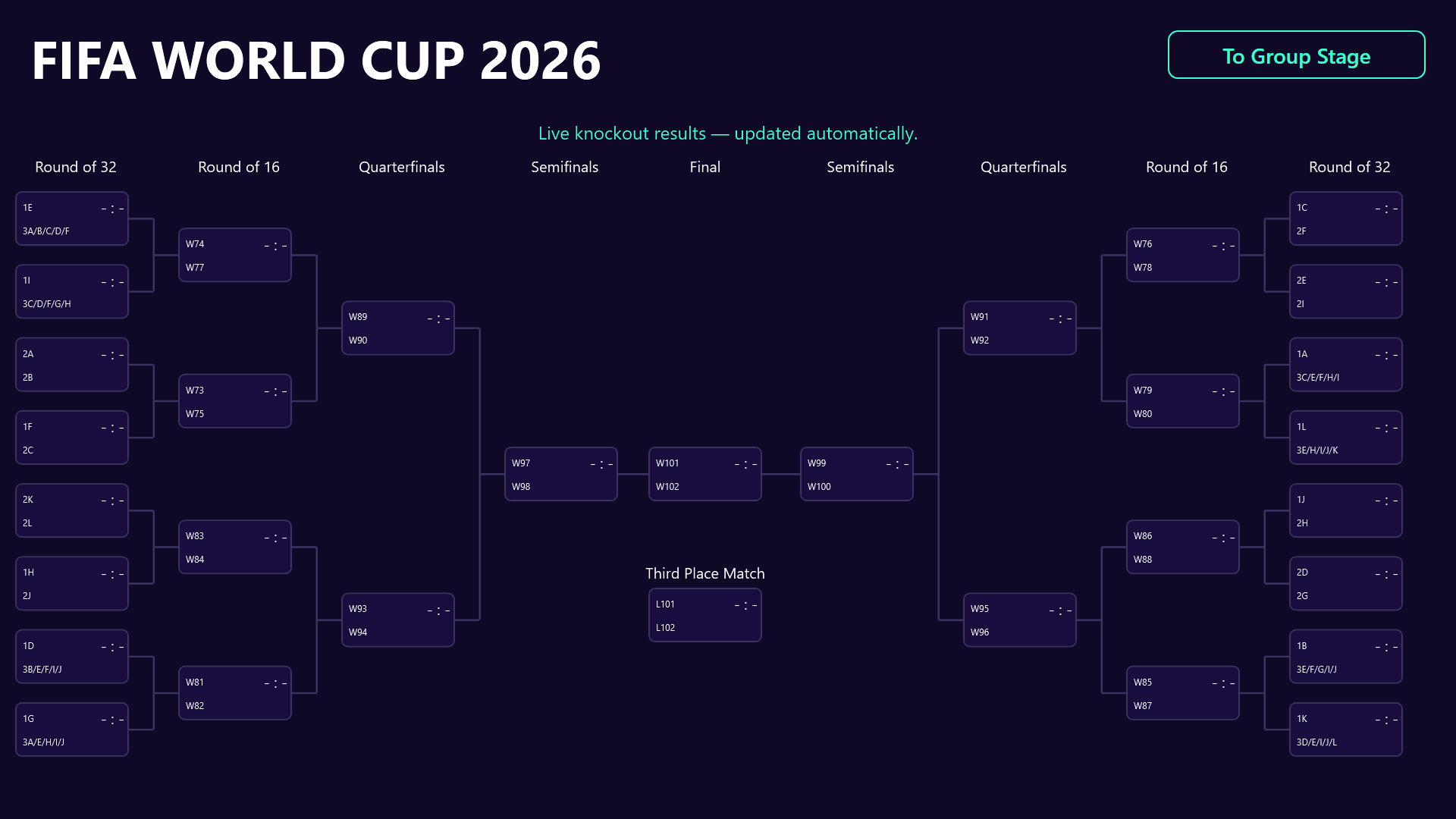
The second screen shows the knockout phase as a proper tournament bracket. It grows from the round of 32 through the round of 16, the quarter-finals, the semi-finals, and on to the final, so it is easy to see who plays whom and how the path to the title is taking shape.
As the group stage resolves and teams advance, the bracket fills in automatically from the same live feed. The result is a single screen that tells the whole story of the elimination rounds at a glance - a natural companion to the group stage view and exactly the kind of thing a crowd gathers around once the tournament reaches its decisive phase.
Minimal interaction by design
Interaction is intentionally kept to almost nothing. The board switches between the group stage and the knockout bracket with a single tap, which suits both a wall-mounted touch screen and a passive display running on a timer. There are no menus to navigate and no settings to fiddle with - it is built to be left alone and simply watched.
That restraint is the point. A signage board earns its keep by being reliable and effortless, and this one delivers both because the data does all the work.
Result
The finished board is a self-maintaining World Cup display. It reads the real draw and live results from a free online feed, recalculates every group table and the full knockout bracket on its own, and presents both as clean, glanceable screens that a crowd can read from across the room. You set it up once, mount it on the wall, and it keeps itself current for the entire tournament - no manual updates, no errors, no fuss. Download the project file from the sidebar and have your own World Cup 2026 board running in minutes.